Municipalities and local government
Review resident calls to a city or county line for the service request details, the transfer to the right department, and the case number given.
Municipalities and local government call review
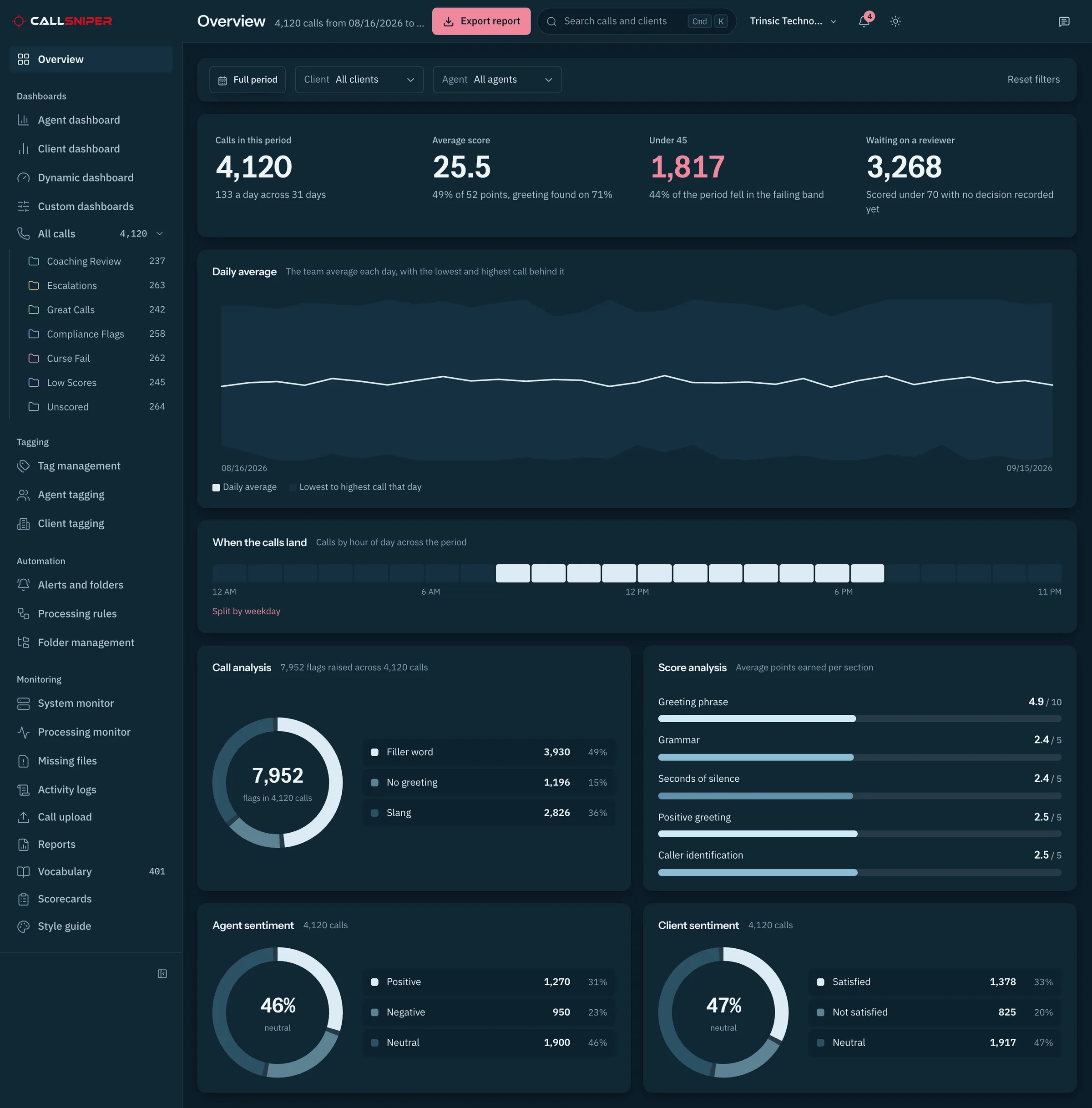
A contact center that answers under its own name is accountable to the people it serves and to whoever oversees it. CallSniper transcribes and scores the recordings you provide against the standard your organization set, so the answer to what was said on a call is a transcript and a score rather than a recollection.
A center taking three thousand calls a day and hand scoring thirty of them holds a sample too thin to act on. CallSniper reviews every recording you send against the scorecard your team defines, so the trend in the report comes from the day rather than from whoever had time to listen.
Follow one call through the platform67%Call score
4 of 6 checks passed
3 moments flagged on this call
No name given
The greeting named the company, and the agent never said who she was.
Call transcript
Thank you for calling Ferncrest Plumbing and Drain, how can I help?
My water heater is leaking all over the garage floor.
That sounds stressful. Let me get a technician out to you.
Please. It has been going for twenty minutes.
Is the water spreading toward anything electrical?
Not yet. This is Marcus Bell, and my number is 555-0147.
Got it. I am sending this to the on call technician now.
Sample call. The flagged moments come from your own scorecard.
An outage report and a permit question share nothing except a caller who has no alternative. Write the checks your organization already holds people to, and every recorded call is measured against the same list.
Select a check and the transcript highlights the line behind the result.
How a score is traced67%Call score
4 of 6 checks passed
Call transcript
Thank you for calling Ferncrest Plumbing and Drain, how can I help?
My water heater is leaking all over the garage floor.
That sounds stressful. Let me get a technician out to you.
Please. It has been going for twenty minutes.
Is the water spreading toward anything electrical?
Not yet. This is Marcus Bell, and my number is 555-0147.
Got it. I am sending this to the on call technician now.
What the scorecard listened for
The greeting named the company, and the agent never said who she was.
Sample call. The checks come from your own scorecard.
Rules act on score, account, tag, and call length. Routine issues collect in a folder for the next review session, and a critical violation goes out by email or Slack once the call finishes processing.
Drag the score to see how many calls the rule would catch.
Explore review workflowsWhen a call scores below 70%, file it in the Coaching folder and email the supervisor.
9 of this week’s 60 calls would be filed and flagged.
and 6 more
Sample week. Rules use your own scorecard and your own folders.
A council member, a board, or the resident on the call asks what was said back in March. Reports run by agent and by client account, transcripts stay searchable by phrase, and every finding opens at the second that produced it, the way the flagged call earlier on this page does.
Each page carries an example scorecard, the call moments it checks, and what to bring to a pilot. The criteria are a starting point for the standard your operation already publishes.
Review resident calls to a city or county line for the service request details, the transfer to the right department, and the case number given.
Municipalities and local government call reviewScore recorded calls from an emergency communications center against the guidelines your own QA program approved, with the transcript behind each finding.
911 and emergency communications call reviewReview utility calls for hazard handling, outage and service address capture, payment arrangement terms, and the disconnection language your tariff allows.
Utilities call reviewReview association calls for the owner's request, the governing document answer, the work order that followed, and the board escalation path.
HOAs and community associations call reviewScore the first-notice-of-loss calls your own claims center takes for intake facts, approved coverage language, and the adjuster handoff.
Insurance claims call reviewReview submitted support calls where ticket intake, identity verification, severity classification, or escalation left the path your team approved.
IT help desks and technical support call reviewHold one brand standard across every queue, site, and outsourced overflow partner, and open the transcript behind any score a team lead disputes.
Branded in-house call centers call reviewCall audio, transcripts, and scores sit in an environment built for your organization alone, and the model that reads them runs in that same cloud. Recordings never travel to a public model provider, and customer datasets do not intermingle.
Enter the calls your center handles in a day. The rate card sets the license and the processing fee from there.
91,250 calls a month, counted across the full year.
CallSniper at this volume
$2,908.75per month
91,250 calls processed at $0.032 each.
$2,220,795 less each year than reviewing this volume by hand.
Ask for a written proposal3,000 calls a day x 365 / 12 = 91,250 calls a month. The license covers the first 30,000, which leaves 61,250 calls at the 75,000 usage level, $0.0230 each.
$1,500.00 license + $1,408.75 processing = $2,908.75 a month, $34,905 a year. Human review of the same volume at $2.06 a call runs $2,255,700 a year.
These figures come from CallSniper’s current rate card, and a written proposal confirms them for your account.
Start with one queue, one standard, and one month of recordings.
Prepare a demo briefNo. Scoring covers the calls nobody had time to reach and shows the transcript passage behind each result. Calibration, coaching, and the judgment call on a disputed score stay with your people.
Yes. Include the department, the queue, or the site in the upload data, and each set can carry its own scorecard, routing rules, folders, and reports. An agent who covers several queues is scored against the standard for each call.
Run one scorecard across both sets of recordings and read the reports by agent and by account. That gives calibration a shared starting point instead of two team leads working from the calls they happened to pull.
Transcripts are searchable by phrase and carry timestamps, so a supervisor can find the calls where an address, an account, or a commitment came up and open each one at that moment.
Bulk upload from your phone platform is the day one path, with per file processing status. A connection to your contact center system gets scoped during the evaluation, along with the file formats and handling requirements.
Ask for a scoped proposal based on your call volume, review needs, and setup requirements. Pilot terms and pricing will be confirmed directly by CallSniper.
Tell us which queue your supervisors argue about, and we will show how CallSniper applies your criteria to a real call from it.